Gamification of Trading and Consumer Protection in Colombia: The Challenges of Using Foreign Platforms
By Daniel Peña Valenzuela, Partner Peña Mancero Abogados
Introduction
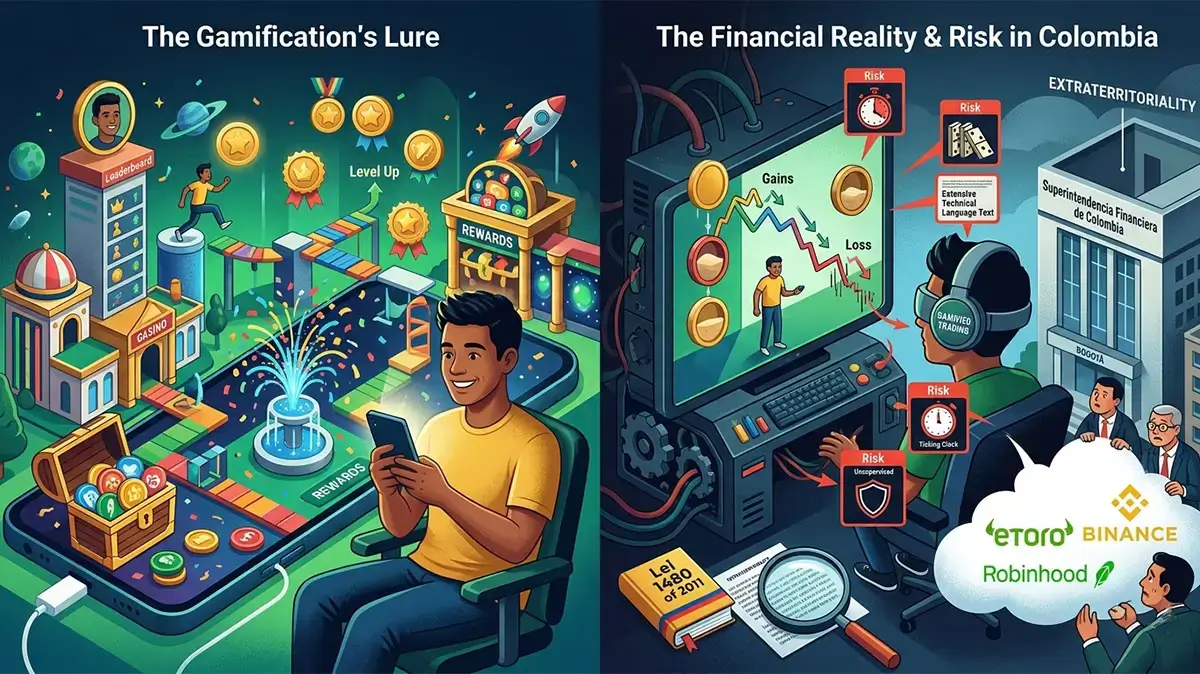
Gamification in trading has become a central strategy for digital platforms to attract and retain users. Through playful elements such as badges, rewards, leaderboards, and visual notifications, trading is transformed into a game-like experience. However, in Colombia, this practice raises serious consumer protection concerns, particularly when foreign platforms operate beyond the direct supervision of the Colombian Financial Superintendence.
This article examines the risks of gamified trading for Colombian consumers, highlights examples of international platforms such as Robinhood, eToro, and Binance, and proposes regulatory and cooperative mechanisms to mitigate digital manipulation in financial markets.
Dynamics of Gamification and Risks for Colombian Consumers
The logic of gamification in trading relies on behavioral stimuli designed to encourage frequent transactions. These stimuli, such as badges or visual rewards, create a sense of immediate achievement that can push users to repeat actions without properly assessing risks. A clear example is Robinhood in the United States, which was criticized for using digital confetti after trades, reinforcing emotional bias toward repeated trading.
Risks for Colombian consumers are significant. Gamification exploits behavioral biases such as loss aversion and the illusion of control, leading to impulsive decisions. Moreover, the extraterritoriality of platforms like eToro, based in Cyprus, or Binance, registered across multiple jurisdictions, makes direct oversight by the Colombian Financial Superintendence difficult. Finally, the information provided by these platforms often fails to meet the transparency standards required under Law 1480 of 2011, leaving consumers exposed.
Practical examples highlight these dynamics. Robinhood encourages high-frequency trading through simple interfaces and attractive visual cues. eToro promotes “copy trading,” where users replicate other investors’ strategies, potentially leading to uninformed decisions. Binance offers rewards and gamified token use, exposing consumers to volatile assets and increasing financial risk.
Conclusions
Gamified trading poses a challenge to consumer protection in Colombia. While it fosters financial inclusion, it also exposes users to manipulation and excessive risk. Needed measures include:
- International cooperation: bilateral and multilateral agreements to supervise foreign platforms.
- Warning protocols: clear digital messages about behavioral and financial risks.
- Financial education: programs teaching consumers to identify gamification techniques and their effects.
- Adaptive regulation: rules integrating consumer protection principles for digital and cross-border platforms.

Issuance of a Statement of Objections against Rappi

Data Protection & Privacy